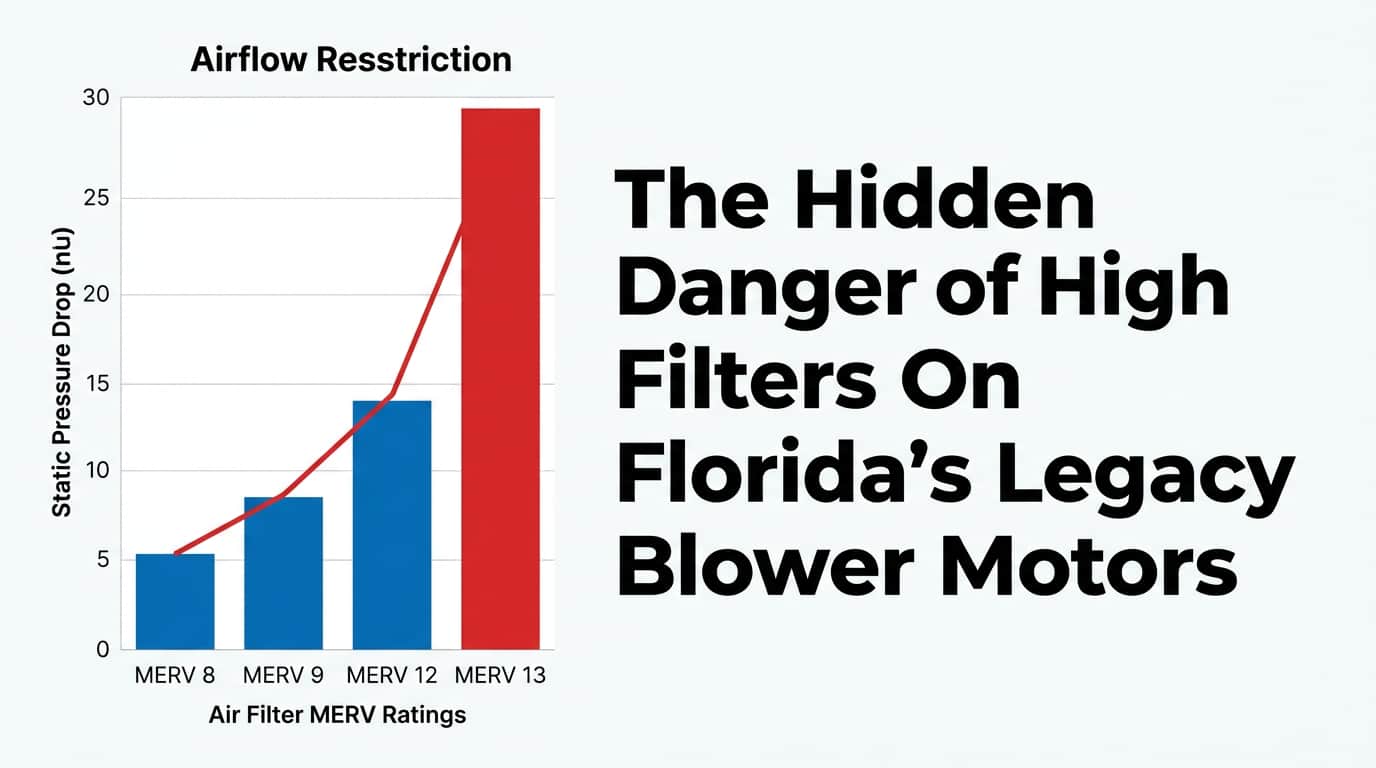
That high-efficiency filter you just installed might actually be destroying your property's older AC equipment. Here in Orlando, Florida, we constantly see well-meaning commercial property managers accidentally suffocate their legacy blower motors with dense pleated filters. If you need help repairing a frozen coil right now, contact Discount Air Supply LLC at (407) 951-5050.
What Are MERV Ratings on AC Filters?
MERV stands for Minimum Efficiency Reporting Value, measuring how effectively a filter traps airborne particles. Ratings range from 1 to 16 for standard commercial use. A higher number means the filter catches smaller particles like dust and pollen. However, these denser filters also restrict how much air can pass through your system.
Most commercial properties use filters between MERV 4 and MERV 13. While a MERV 13 filter does an excellent job cleaning the air, it acts like a thick blanket over your face when you try to breathe. This restriction becomes a massive problem for older equipment. If you manage properties near downtown Orlando, you know older buildings often have legacy systems that just cannot handle that level of airflow resistance.
How Do Older AC Blower Motors Work?
Legacy blower motors operate at a single fixed speed and push a specific amount of air regardless of the resistance they face. These are typically standard Permanent Split Capacitor (PSC) motors. When a dense filter blocks that airflow, the motor cannot speed up to compensate, leading to dangerous heat buildup and system stress.
Think of these older motors like a car stuck in one gear. If you start driving up a steep hill, the engine strains. In our 15 years serving Central Florida, we've learned that these older single-speed motors constitute about 40% of the active units in historic areas like Winter Park. They rely entirely on proper air circulation to keep the motor windings cool. When you cut off that air supply with a restrictive filter, the motor bakes itself to death. You will call a local provider of AC supplies Orlando, Florida, to buy a replacement part.
Why Do High MERV Filters Cause Coils to Freeze?
High MERV filters slow down the warm air moving over your AC's indoor evaporator coil. Without enough warm air passing over the cold copper tubes, the condensation on the coil turns to solid ice. This freezing completely blocks airflow and can destroy your compressor if left running.
This is the number one cause of frozen coils our technicians see in the field. When the coil freezes, it acts like a wall of ice inside your air handler. Your system keeps running and burning expensive electricity, but no cold air reaches your tenants. We recently saw a commercial property manager lose three central air conditioning systems in one week because they switched to MERV 13 filters on 12-year-old PSC motors. The repair costs easily hit $1,500 per unit for new compressors.
Why Are Florida AC Units at Greater Risk?
Orlando's 90-degree summers and 80% average humidity force commercial AC units to run almost constantly from April through October. This nonstop operation gives an overheating blower motor zero time to cool down. The massive moisture load also means coils freeze much faster when airflow drops.
Northern states have short cooling seasons. Here, your equipment fights a daily battle against extreme heat and moisture. If your airflow drops by just 20% due to a thick filter, your system loses its ability to pull humidity out of the air. You end up with a sticky, uncomfortable building and skyrocketing power bills. Sourcing proper AC supplies Orlando, Florida, helps you avoid these costly and climate-specific failures.
How Do You Know If Your Blower Motor Is Struggling?
Listen for a loud humming or whining sound coming from the air handler. You will also notice weak airflow coming from the ceiling vents and higher indoor humidity levels. Your monthly energy bill will likely spike by 15% to 25% as the system runs longer to hit the target temperature.
A struggling motor pulls high amperage right before it fails. If your maintenance team uses a multimeter, they can check the amp draw. If it exceeds the manufacturer rating printed on the side of the motor, the filter is likely too restrictive. Catching this early saves you from having to buy brand-new home package air conditioning units before your capital budget allows for it. We highly recommend having your technicians check this amp draw during their routine monthly walkthroughs.
What Is the Best Filter for Older Florida HVAC Systems?
Stick to a MERV 7 or MERV 8 pleated filter for older commercial units with single-speed motors. These filters catch common dust and pollen without choking the blower motor. Replace these filters every 30 days during the intense Florida summer to maintain safe airflow levels.
We constantly source AC supplies Orlando, Florida, for property managers who learned this lesson the hard way. A basic MERV 8 filter provides the perfect balance of airflow and dust protection. If your tenants need hospital-grade air quality, you cannot just slap a MERV 13 filter in a 15-year-old unit. Instead, you need to install a standalone HEPA air purifier or upgrade to a modern variable-speed air handler.
Is a Higher MERV Rating Always Better for Air Quality?
No, a higher MERV rating actually ruins your indoor air quality if your fan motor cannot push air through it. If the motor strains and airflow drops, the system stops circulating the air in your building. Stagnant air leads to rapid mold growth and uncomfortable humidity inside your property.
We saw this happen in a large retail complex near the Florida Mall. They installed MERV 14 filters to improve air quality. Within two weeks, the restricted airflow caused the indoor humidity to hit 75%. Mold started growing on the ceiling tiles. They had to pay a remediation company $4,000 to clean the mess. The right filter must always match the mechanical limits of your specific equipment. Discount Air Supply LLC always advises matching your filtration goals with your equipment's actual capabilities.
Protect Your Commercial AC Equipment
Keep your legacy systems running smoothly by checking those filters today. Drop the MERV rating down to 7 or 8 if you have older single-speed blower motors. Your equipment will run cooler, your coils will stay ice-free, and your utility bills will drop. If your coils are already frozen or you need reliable commercial equipment, contact Discount Air Supply LLC at (407) 951-5050.