Florida's commercial properties face a tough reality every summer: HVAC systems run nearly 24/7 from April through October, fighting 90°F+ heat and humidity that regularly exceeds 75%. If you manage a commercial building in Central Florida, the equipment decisions you make right now will directly affect your operating costs for the next decade.
Need help choosing the right system for your property? Call Discount Air Supply LLC at (407) 951-5050 to speak with a local expert today.
What Do Florida's 2026 HVAC Efficiency Mandates Actually Require?
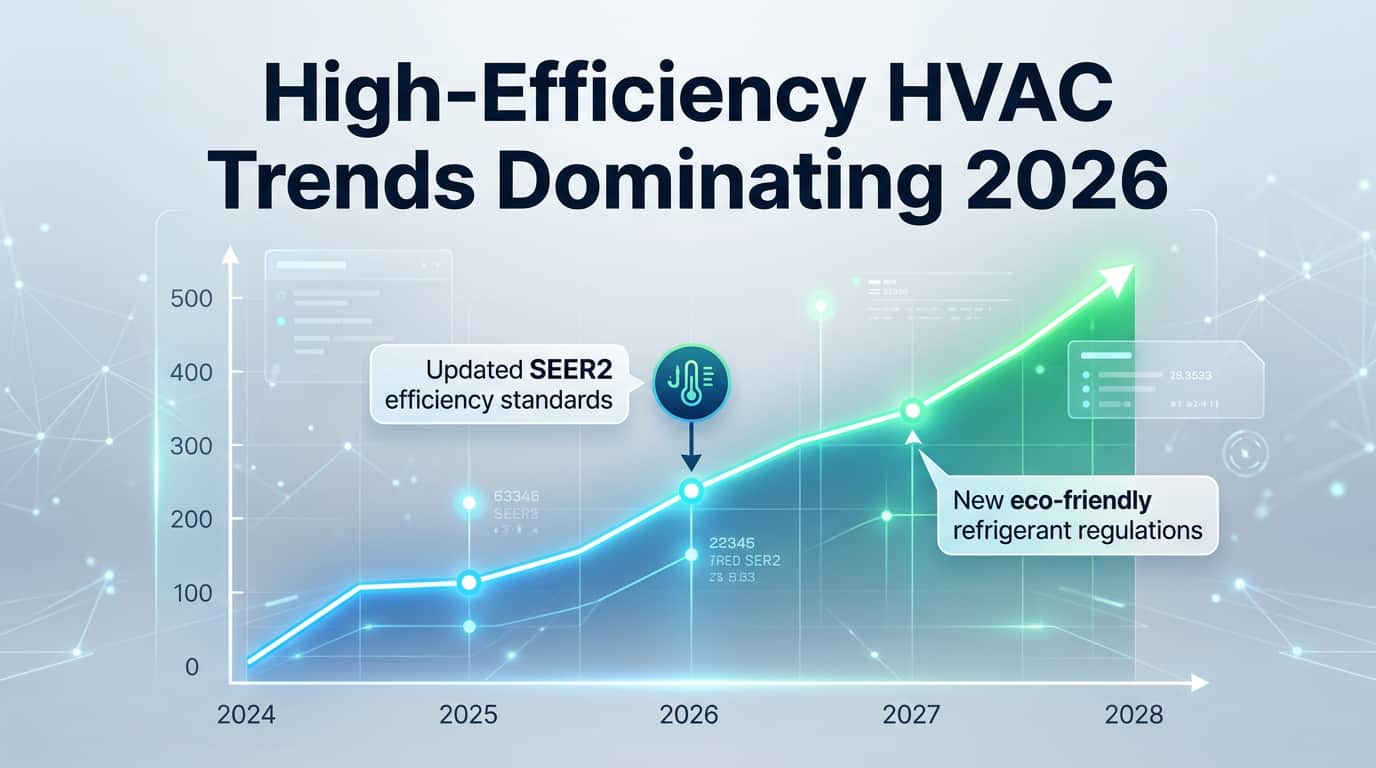
Florida's 2026 HVAC standards require all new residential and light commercial split systems to meet a minimum 15 SEER2 rating, up from the previous 14 SEER standard. That shift might sound minor, but in practice, it means older equipment installed before 2023 will no longer be code-compliant for replacement-in-kind. Commercial property managers replacing rooftop units or central air conditioning systems need to factor this into their 2026 capital planning.
Why does the rating change matter so much here? Florida properties run their systems roughly 2,000 to 2,500 hours per year, compared to about 750 hours in northern states. Every point of SEER2 efficiency you gain delivers measurably more savings per square foot when the runtime is that high.
How Are Smart, AI-Driven Systems Changing Humidity Control in Central Florida?
Modern AI-driven HVAC controls now manage humidity independently from temperature, a distinction that matters enormously for commercial buildings in Orange County and Seminole County. Traditional thermostats cool to a set temperature and stop. Smart systems use occupancy sensors, outdoor weather feeds, and historical load data to pre-condition spaces before peak humidity hours, typically between 2 PM and 6 PM during Central Florida's afternoon storm season.
Our technicians typically find that buildings in areas like Lake Nona's medical district, where foot traffic surges mid-morning, see 12% to 18% reductions in peak demand charges after switching to AI-managed climate controls. The system learns the building's thermal patterns over 30 to 60 days and adjusts staging automatically. Less short-cycling means less wear on compressors, fewer service calls, and lower monthly utility costs.
Will a High-SEER2 System Actually Lower My Utility Bills in Florida?
Yes, meaningfully. A property upgrading from a 14 SEER unit to an 18 SEER2 variable-speed system can expect energy cost reductions of 20% to 30% on cooling-related consumption. For a 10,000-square-foot commercial space running a 10-ton system in the Orlando area, that typically translates to $1,800 to $3,200 in annual savings, depending on occupancy patterns and building envelope quality.
Properties in Casselberry and Winter Springs, where hard water is common, often see additional savings because high-efficiency systems with better coil protection don't scale up as quickly. Scaling reduces heat transfer efficiency, which drives up runtime. Keep coils clean, and those efficiency gains hold for the full rated system life of 15 to 20 years.
What Does the R-410A Phase-Out Mean for Commercial Property Managers?
R-410A refrigerant is being phased out under EPA regulations, with new equipment sales ending in 2025 and service supplies tightening through 2026 and beyond. Replacement refrigerants like R-454B and R-32 have significantly lower global warming potential, roughly 78% lower than R-410A in the case of R-454B.
For property managers, the practical concern is service cost. R-410A prices have already risen 40% to 60% in some Florida markets as supply tightens. If your current systems still run on R-410A and are more than eight years old, a leak repair could cost $400 to $900 just in refrigerant charges alone, before labor. Transitioning to new equipment now, while installation labor is still predictable and HVAC supplies in Central Florida are well-stocked, is generally more cost-effective than maintaining aging R-410A systems through 2027 or 2028.
You can browse available home package air conditioning units and central systems at Discount Air Supply LLC to compare current options that use next-generation refrigerants.
How Do You Choose the Right Variable-Speed System for a Florida Commercial Property?
Variable-speed systems are the right call for most Florida commercial applications, but the sizing and staging still have to match the building load. Here's a straightforward framework:
Match tonnage to actual load, not square footage. A common error we see on commercial jobs is oversizing by 20% to 30% because a contractor defaulted to square footage rules of thumb. Oversized variable-speed equipment short-cycles, reducing dehumidification and accelerating compressor wear.
Prioritize latent capacity for high-occupancy spaces. Restaurants, retail spaces, and medical offices in areas like Dr. Phillips and MetroWest have high internal moisture loads from people and cooking. Look for equipment with a sensible heat ratio (SHR) below 0.75 for these applications.
Check for demand response compatibility. Florida utilities increasingly offer demand response incentive programs for commercial customers. Systems with BACnet or Modbus communication can integrate directly with these programs, earning credits during peak grid hours.
Verify SEER2 ratings against Florida's climate zone. Equipment SEER2 ratings are tested under standard conditions. Florida's Climate Zone 1 runs hotter and more humid than the test baseline, so real-world performance may sit 5% to 10% below the rated value.
What Maintenance Practices Extend the Life of High-Efficiency Units in Florida?
High-efficiency systems require more attention than standard units, not less. The tighter tolerances that make them efficient also make them more sensitive to dirty coils, restricted airflow, and refrigerant charge variations.
Schedule preventive maintenance twice per year: once in March before the cooling season starts, and again in October before any heating demand. Each visit should include coil cleaning, refrigerant charge verification (within 0.5 oz of spec), filter replacement, and condensate drain inspection.
In our experience serving properties across Central Florida, the single most common reason a high-efficiency system underperforms is a partially blocked evaporator coil. Coil fouling reduces heat transfer and forces the compressor to run longer to hit the setpoint, erasing the efficiency gains you paid for. On a 5-ton commercial unit, a fouled coil can add $60 to $120 per month to the utility bill.
Replace filters every 30 to 45 days during peak season. For properties near I-4 construction corridors or high-traffic retail centers, airborne particulate loads are higher than average, and monthly changes are a minimum, not a suggestion.
Ready to Upgrade Your Property's HVAC Systems?
The 2026 mandate changes, refrigerant transition, and growing availability of AI-driven variable-speed equipment all point in the same direction: now is the right time to assess your Central Florida property's HVAC inventory and plan your next equipment cycle.
Discount Air Supply LLC carries central systems, package units, and commercial equipment at competitive prices, with local pickup available in Casselberry. Call (407) 951-5050 to speak with someone who knows Central Florida's commercial HVAC requirements and can help you find the right equipment for your property.